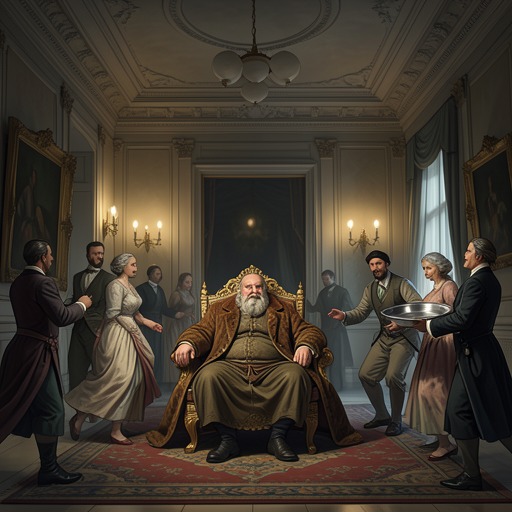
History of power
War and PeacePower in history is the novel’s central challenge to the belief that historical events are caused by the conscious will of celebrated leaders. The concept is developed most fully in the historical-philosophical chapters on the 1812 campaign, where Napoleon’s orders, the actions of Mikhail Kutuzov, the movement of armies, and the decisions of whole populations are examined as parts of one interconnected process. Its decisive claim is that the apparent command of one ruler becomes historically effective only when it coincides with the activity of many people; the commander appears to cause the event, but the event also determines which commands will be obeyed and which will disappear without effect.
From Heroic Causation to Historical Law
The argument begins by rejecting the older explanation that God directly directs nations through chosen heroes, as well as the modern habit of treating prominent individuals as the primary causes of history. The ordinary historical account says that Napoleon wanted the West to move against the East and that the movement occurred because he wished it. The novel compares this explanation to the ancient belief that the earth stood still while the planets moved around it: both mistake an appearance for an intelligible law. Human beings naturally seek a single, graspable cause, and therefore seize on the first prominent will available, but the complete causes of an event exceed the mind’s ability to comprehend them.
The 1812 campaign exposes the weakness of this heroic model. The Battle of Borodino was fought on August 26 after the Battle of the Shevardino Redoubt on August 24 and a day without firing on August 25. Its immediate consequences were disastrous for both sides: the Russian army was brought nearer to the loss of Moscow, while the French army was brought nearer to the destruction of its entire force. Before Borodino the Russian strength was approximately one hundred thousand against the French one hundred and twenty thousand; afterward the Russian army had little more than fifty thousand against a French force of about one hundred thousand. Yet Napoleon offered the battle and Kutuzov accepted it. The outcome therefore cannot be explained simply as the rational execution of a commander’s plan or as the triumph of individual genius.
What Power Means
The novel examines the juridical definition that power is the collective will of the people transferred, by expressed or tacit consent, to rulers. This formulation is useful because it recognizes that authority depends on a relation between the ruler and the people rather than on the ruler’s physical strength or moral superiority. It is insufficient, however, when treated as a timeless substance existing outside history. For history, the state and power are phenomena that change over time, not fixed objects whose nature can be defined once and for all.
The definition immediately generates contradictions. If power is the people’s will transferred to a ruler, the reader must ask whether Pugachev represented that will, why Napoleon I did, or why Napoleon III was treated as a criminal in one circumstance and as a legitimate ruler in another. The same difficulty appears in palace revolutions, conquests, alliances, and international domination: it is unclear whether the people’s will is transferred unconditionally, conditionally under known rules, or conditionally under rules that remain unknown. Historical theories that try to preserve the idea of delegation therefore turn exceptions into accidents, usurpations, or deviations from an abstract model.
The book finally defines power not as a possession but as a relation. It belongs to the person whose opinions, predictions, and justifications are most closely associated with collective action, while that person takes the smallest direct share in performing the action itself. This explanation accounts for the visible authority of a ruler without mistaking visibility for causation. The more an individual stands at the apex of a collective structure, the more the event is morally attributed to that individual and the less directly that individual participates in its physical execution.
The Army as a Model of Collective Action
An army provides the clearest image of this relation. Its organization resembles a cone: the rank and file form the broad base, noncommissioned officers occupy a smaller level above them, officers stand higher still, and the commander in chief forms the apex. The soldiers perform the stabbing, hacking, burning, and pillaging, while receiving orders from above; the commander in chief gives general directions concerning the movement of the mass and does not personally perform the acts that make the campaign visible in physical terms.
This structure does not mean that the lower ranks are irrelevant or passive. The largest number of people takes the greatest direct share in the event, while the smaller number above them assumes less physical participation and greater apparent responsibility. The same arrangement extends beyond warfare into agriculture, trade, administration, and every other organized form of common activity. Collective action requires differentiated roles, but the existence of a commanding apex does not transform the apex into the sole source of the action.
The narrative repeatedly places abstract power beside embodied discipline. Near the enemy, Russian soldiers calmly build shelters, dry clothing, mend boots, wait for porridge, and receive vodka, even though many will soon be left on the battlefield. In the same military environment, a thief is held down and beaten while a major declares that a soldier must be honest, honorable, and brave. These scenes show power operating through routine, hierarchy, bodily punishment, inspection, and shared assumptions about duty. They also reveal that order is not identical with moral goodness: the same institution that creates cohesion can administer violence through commands that appear legitimate within its structure.
Commands, Events, and the Illusion of Causation
The historical error lies partly in the way events are narrated after they have occurred. Thousands of diverse and petty occurrences are compressed into a single event, and a long series of commands is compressed into one apparent expression of will. Thus history says that Napoleon wished to invade Russia and invaded it. In reality, his activity consisted of many orders, some executed and many unexecuted, moving in different and uncertain directions. The orders connected with the 1812 campaign succeeded not because they possessed a special quality, but because they coincided with the larger course of events that carried the French army into Russia.
The relationship is illustrated through the image of a ship and the wave before it. A wave appears to anticipate and even guide the ship, but close observation shows that its movement is produced by the ship’s own forward motion. Historical commands work similarly. Once an event has occurred, the commands compatible with it appear prophetic, while the countless commands that failed to produce anything are forgotten. The apparent foresight of the leader is therefore a retrospective effect created by selection, generalization, and the observer’s failure to follow events moment by moment.
This principle also governs smaller scenes. When Prince Andrei Bolkonsky orders a drunken officer to let a doctor’s wife pass, the command succeeds only within a particular relation of rank, urgency, resistance, and physical presence. The officer initially asserts that he is in command, threatens Prince Andrei, and turns the encounter into a performance of authority. Prince Andrei’s raised whip and furious insistence alter the relation, but the episode does not demonstrate that words alone create obedience. It exposes power as a precarious interaction involving institutional position, bodily force, fear of ridicule, and the immediate pressure of circumstances.
The Masses and the Limits of Great-Man History
The force that moves nations is therefore not power understood as the possession of a ruler, nor intellectual activity, nor a combination of the two. It is the activity of all who participate in an event, arranged so that those who take the largest direct share bear the least responsibility, while those who act least directly appear to bear the most. The moral appearance of causation belongs to the wielder of power; the physical execution belongs to those who submit to it. The cause cannot be assigned wholly to either side, because moral activity cannot exist without physical activity.
The book applies this reasoning to Napoleon’s political and military history. Conventional accounts turn a long chain of European conflicts into a story of personal intention: Napoleon conquers, commands, captures Moscow, and then suddenly retreats, while Alexander I gathers opposition and restores the balance of Europe. The novel presents this as a seductive but inadequate narrative because it turns innumerable relations, responses, failures, and collective movements into the biography of one man. The very acts that appear to express a ruler’s will are selected only after events have confirmed them.
The same critique governs the treatment of the Russian nobility and wartime administration. At a Moscow assembly, Count Fyodor Rostopchin calls for men rather than discussion, and the nobility resolves to furnish ten fully equipped men for every thousand serfs. The Emperor’s emotional thanks makes the decision appear to flow from sovereign authority, yet the resolution is produced through the assembled interests, resources, institutional forms, and expectations of the social body. Elsewhere, Pierre Bezukhov attempts to reform his estates by promising freedom for his serfs, lighter labor, protection for nursing women, noncorporal punishment, hospitals, asylums, and schools. His intentions are filtered through stewards who fear, mock, or exploit them, demonstrating again that an order changes meaning as it passes through a network of people.
Narrative and Thematic Significance
Power in history gives War and Peace a method for resisting both the worship of heroes and the fantasy that events can be explained by one transparent cause. Napoleon may issue decrees, Alexander I may command, Kutuzov may accept a battle, and officials may punish or mobilize, but each command enters a world already structured by armies, institutions, habits, fears, material conditions, and the actions of countless people. The narrative’s battle scenes, public assemblies, punishments, reforms, and private crises continually turn abstract authority into a visible relation between bodies.
The concept also joins political philosophy to moral judgment. When prisoners are led to a post and placed in order for execution, Pierre Bezukhov experiences the system as something that annihilates him even though no single person seems fully responsible. When Vereshchagin is presented to the Moscow crowd as the man whose actions have caused the city’s ruin, official accusation attempts to concentrate a national catastrophe in one vulnerable body. Such scenes show the practical danger of great-man explanations: they make collective violence appear simple by assigning it to a named traitor, commander, or ruler.
The final implication is not that individuals are unreal, but that their significance must be understood through their relation to the masses and to the continuity of events. Historical persons express, justify, and sometimes organize collective action, yet they do not stand outside the movement they seem to govern. Power is real as an observable relation, but it is not an independent force that commands history from above. The movement of nations emerges from the union of commands and obedience, direct action and indirect responsibility, individual will and the wider activity that makes that will effective.